
Highlights
- Sweden's state-owned LKAB is relocating the entire Arctic town of Kiruna to access the Per Geijer deposit, Europe's largest rare earth resource at approximately 2.2 million tonnes, as part of the continent's push for mineral independence from China.
- While the deposit scale is significant, Europe still lacks commercial-scale separation, refining capacity, and magnet manufacturing—meaning a resource discovery alone won't break China's 90%+ downstream dominance.
- For U.S. stakeholders, Kiruna signals allied mineral realism but underscores the urgent need for coordinated transatlantic investment in processing infrastructure, not just upstream mining.
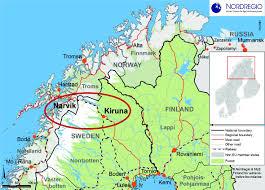
A recent Oilprice.com feature (opens in a new tab) by Tsvetana Paraskova captures a striking image: Sweden’s mining champion LKAB (opens in a new tab) relocating the Arctic town of Kiruna—including its 113-year-old wooden church—as mine expansion and ground subsidence make the move unavoidable. The visuals are dramatic, but the strategic subtext matters far more.
Beneath Kiruna lies the Per Geijer deposit, which LKAB has reported at more than one million tonnes of rare earth oxides—with later disclosures suggesting ~2.2 million tonnes in situ—widely regarded as the largest known rare earth resource in Europe. For a continent anxious about China’s dominance in rare earths, the symbolism is powerful: Europe is literally moving a town to keep critical minerals accessible.
Table of Contents
Kiruna, Sweden
LKAB: A Heavyweight With a Long Horizon
Founded in 1890, LKAB (Luossavaara-Kiirunavaara Aktiebolag) is a wholly state-owned Swedish mining group, headquartered in Luleå, with core operations in Kiruna and Gällivare. It is one of the world’s leading suppliers of high-grade magnetite iron ore pellets and fines, serving steelmakers across Europe and Asia. Beyond iron ore, LKAB produces industrial minerals and provides drilling systems and engineering services globally. Strategically, the company positions itself at the forefront of decarbonizing heavy industry, targeting carbon-free steelmaking processes by 2045 through innovations such as green sponge iron and energy-efficient pelletizing. This long-cycle, state-backed mandate shapes how Kiruna’s rare earth potential should be interpreted.
What the Story Gets Right—and Where It Leans
The article is solid on fundamentals. LKAB has publicly confirmed the scale of the Per Geijer resource, and the International Energy Agency consistently underscores the extreme concentration of the rare earth supply chain. China’s dominance—roughly 60% of mining, over 90% of refining, and nearly all permanent magnet manufacturing—is not overstated. Kiruna, therefore, represents a genuine upstream diversification signal.
Where optimism quietly outruns reality is downstream. A deposit does not equal independence, as Rare Earth Exchanges™ continuously chronicles. Europe still lacks commercial-scale separation capacity, solvent expertise, and magnet manufacturing depth. Environmental permitting, radioactive by-product handling, and capital intensity remain formidable hurdles. The narrative edges toward inevitability when execution risk is, in fact, substantial.
Why This Still Matters for the U.S.
For American investors and policymakers, Kiruna is a signal, not a solution. It shows allied nations waking up to mineral realism—but without coordinated transatlantic investment in processing and magnets, China’s structural advantage remains intact. Moving to a town is bold. Building a supply chain is harder.
Disclaimer: This analysis references reporting from Oilprice.com and public statements by LKAB and international institutions. Interpretations are analytical and should be independently verified using primary technical, regulatory, and financial disclosures.
©!-- /wp:paragraph -->


0 Comments